




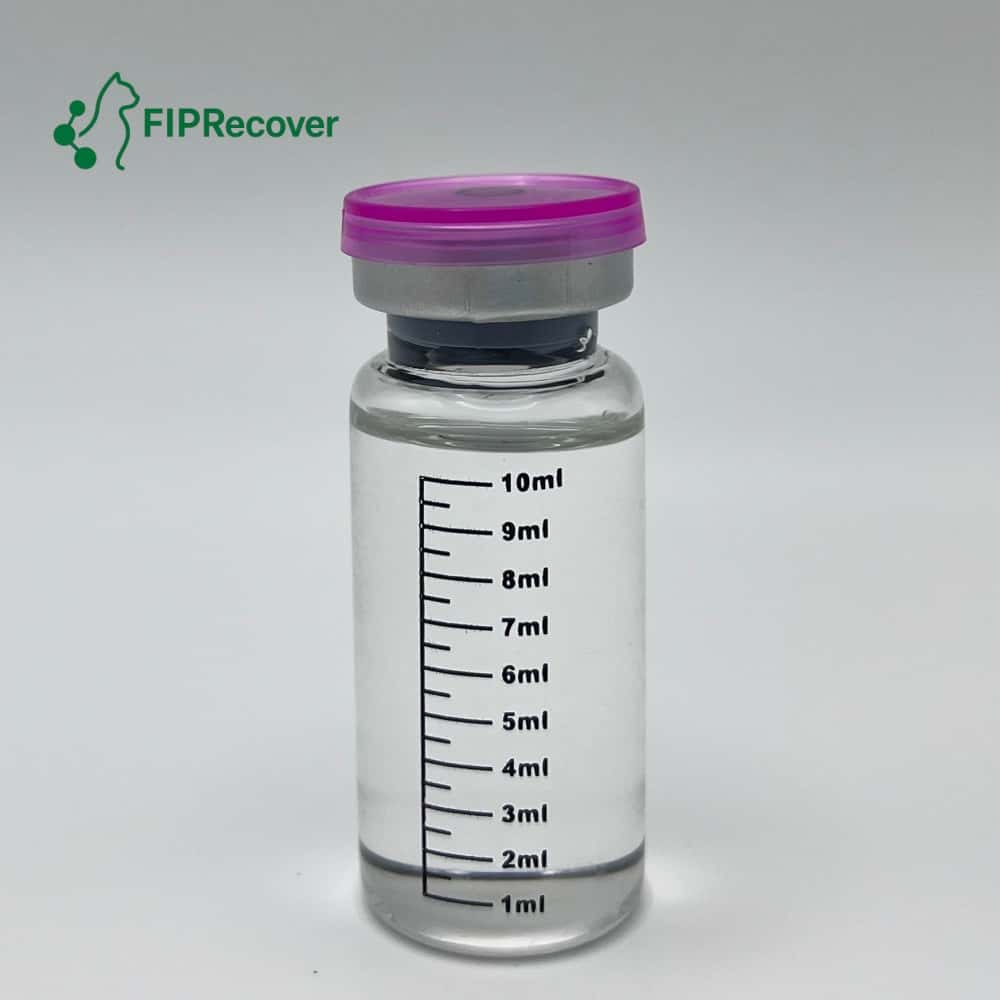
FIPRecover makes the GS-441524 injection at two concentrations: 20 mg/mL and 30 mg/mL. The choice between them is not about which is stronger; it is about the volume a cat receives per injection, and about how many vials a clinic, cattery or distributor must plan across an 84-day course. This article works through the math, the weight bands, and the stock implications.
Both strengths are sterile injections built on the same 99.5% HPLC-tested GS-441524 API, with vial fills of 6, 7, 8 and 10 mL, and both are used under veterinary guidance.
What the Concentration Difference Actually Changes
At the same mg/kg dose, concentration sets the volume. A 3 kg cat on a 4 mg/kg daily dose needs 12 mg. From the 20 mg/mL strength that is 0.6 mL; from the 30 mg/mL GS-441524 injection it is 0.4 mL. The active amount is identical, and the 30 mg/mL strength cuts the volume by roughly a third.
That is the whole trade. Higher concentration buys smaller, easier injections; lower concentration buys a vial that stretches further per milliliter for buyers stocking large caseloads. Everything else, the API, the batch testing, the vial, is the same.
Matching Concentration to Cat Size
Volumetric dosing in FIP practice scales with body weight and presentation: effusive (wet) cases around 0.4 mL/kg, non-effusive (dry) around 0.6 mL/kg, and neurological or ocular presentations around 0.7 mL/kg, which at 30 mg/mL corresponds to the higher 8 to 10 mg/kg dose range. The standard course runs 84 days, extended to 90 or 100 days for severe cases.
For kittens and small cats, the volume advantage is the practical reason to specify 30 mg/mL: a 2 kg kitten on a 4 mg/kg dose draws 0.4 mL from the 20 mg/mL strength and 0.27 mL from the 30 mg/mL strength, and a smaller volume is easier to place subcutaneously and easier for a stressed cat to tolerate. As weight climbs, the absolute volume difference narrows.
Injection sites rotate daily, typically across the scruff and the back behind the shoulder blades, which makes smaller, easier draws a day-to-day comfort for whoever is giving the daily dose. Site rotation and dose setting stay with the veterinary team in each market.
Planning Vials for an 84-Day Course
The table below is the planning shortcut buyers ask for most: daily volume and full-course volume for common cat weights at both concentrations, using the standard volumetric doses. It shows the 30 mg/mL side of the ledger: a third less volume per injection, and smaller vial counts to order, store and cycle through.
|
Cat weight |
FIP type (volumetric dose) |
Daily volume 20 mg/mL |
Daily volume 30 mg/mL |
84-day total 30 mg/mL |
|---|---|---|---|---|
|
2.5 kg |
Effusive (wet), 0.4 mL/kg |
1.0 mL |
0.67 mL |
56 mL |
|
3 kg |
Neurological / ocular, 0.7 mL/kg |
2.1 mL |
1.4 mL |
117.6 mL |
|
4 kg |
Effusive (wet), 0.4 mL/kg |
1.6 mL |
1.07 mL |
90 mL |
|
5 kg |
Non-effusive (dry), 0.6 mL/kg |
3.0 mL |
2.0 mL |
168 mL |
Planning figures assume the full prescribed volume is administered daily for 84 days, under veterinary guidance. Vials are filled at 6, 7, 8 and 10 mL; the practical draw is what the dose works out to.
The 20 mg/mL GS-441524 injection remains the right default for heavier cats, for buyers who want the longest vial life per fill, and for cost-driven stocking where a third more volume per milliliter matters. Many clinics that keep both strengths on the shelf run 30 mg/mL for the small-cat and high-dose work and 20 mg/mL for the rest.
Quality That Stays the Same Across Concentrations
Both strengths are made from the same 99.5% GS-441524 API, and both carry the same release standard: per-batch HPLC testing, a retained sample per batch, and batch numbers that trace each production step. The COA issued per batch covers assay, purity, heavy metals, impurity profile, moisture, melting point and chromatography, with the MSDS alongside.
For a buyer, that means the two concentrations can be stocked side by side without treating one as a separate quality question. The concentration is a specification on the label; the batch record is the same system behind both.
Specifying the GS-441524 Injection for Your Order
When specifying for a practice, cattery or distribution line, the order is three choices: concentration, vial fill, and the mix between them. FIPRecover fills 6, 7, 8 and 10 mL vials at both strengths, so a mixed order matched to an actual caseload beats a single-strength blanket stock. The supply team works from the weight distribution of your caseload to suggest the split.
Ask for the per-batch COA with any order, confirm the label language for your market, and match the batch number on the carton against the documentation on arrival, the same receiving check any API order deserves.
Conclusion
Concentration is a volume decision and a stock decision, not a strength decision: the API, purity and batch testing are identical at 20 mg/mL and 30 mg/mL. Match the concentration to your caseload, plan the vial counts from the table, and the shelf does the rest. The full range of formats is laid out in the FIPRecover product catalog.
Request a COA or a quote from FIPRecover for your mix of concentrations and vial sizes, and plan the stock before the season, not after.
FAQ
Q: Which concentration is better for a 2 kg kitten with FIP?
For most small cats the 30 mg/mL strength is the easier option. A 2 kg kitten on a 4 mg/kg daily dose draws 0.4 mL from the 20 mg/mL strength but only 0.27 mL from the 30 mg/mL strength, a meaningfully smaller injection. The final choice of dose and concentration is made under veterinary guidance, but the volume difference is a practical factor in daily subcutaneous dosing of small cats.
Q: Is the 30 mg/mL injection safer than the 20 mg/mL?
Neither is inherently safer. Both are built from the same 99.5% GS-441524 API with per-batch HPLC testing, and the mg/kg dose is set the same way for both. The 30 mg/mL strength simply delivers the same active amount in roughly a third less volume, which eases daily subcutaneous administration, particularly in small cats and in neurological or ocular cases that run at higher doses.
Q: How many vials should I plan for an 84-day course?
Work from the daily volume and multiply by 84, then divide by the vial fill. For example, a 3 kg cat on a 0.7 mL/kg volumetric dose draws 1.4 mL daily at 30 mg/mL, roughly 117.6 mL across the course, about twelve 10 mL vials. Use the planning table above as a starting point and confirm the split against your caseload with the supply team.
Q: Can I switch concentration mid-course if a cat gains weight?
The dose is recalculated from current body weight, under veterinary guidance, and the concentration is a delivery choice that can follow the weight. The practical note for buyers: if your caseload spans weight bands, stocking both 20 mg/mL and 30 mg/mL GS-441524 injections avoids running out of the strength that fits the patient at that week of the course.

Post Comment